
 EN
EN
WHAT ARE YOU LOOKING FOR?
Borosilicate glass teapots are not just transparent vessels for brewing tea. The shape, capacity, spout structure, handle position, lid fit, and infuser design all affect the practical performance of the finished product.
For retailers, tea brands, hotel suppliers, and private label buyers, these details directly impact whether the teapot is easy to use and clean, whether it sits stably, and whether it is suitable for the target tea market.
Compared to ordinary soda lime glass, borosilicate glass has a relatively low thermal expansion coefficient and better adaptability to temperature changes. These properties make it a practical material for teaware products, but finished teapots should still be used within the specified temperature range and care instructions.
Understanding the following design elements can help buyers more accurately evaluate samples and develop a more functional series of glass teapots.
Even if two glass teapots are made from the same material, they can offer completely different user experiences.
One teapot may pour smoothly, maintain balance when full, and provide ample space for tea leaves to expand; another may have issues like dribbling spouts, unstable holding, or infusers that are difficult to remove and clean.
Therefore, teapot design should not only focus on appearance but also be planned around practical use. Key questions to clarify in the initial stage include:
What type of tea is it primarily used for?
How many people should a pot of tea serve?
Is the product intended for home, teahouses, or hotels?
Do consumers need a built-in infuser?
Is showcasing the tea color and brewing process an important selling point?
Is the teapot sold separately or as part of a tea set?
Answering these questions first allows for more reasonable determination of capacity, spout size, spout, handle, and lid structure.
The shape of the teapot affects the expansion and flow of tea leaves, heat distribution, ease of cleaning, storage space, and overall appearance of the product.
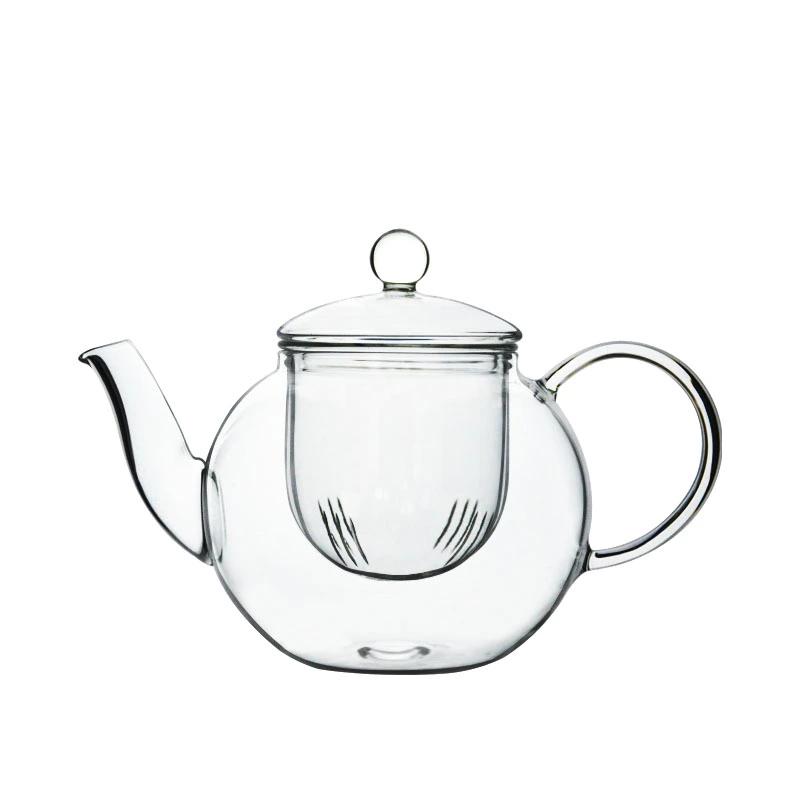
A round teapot has a more traditional silhouette and provides ample space for tea leaves to move during brewing. Taller and narrower bodies can create a modern feel and reduce tabletop space; wider bodies usually offer better stability and are easier to clean inside.
Topglass offers borosilicate glass teapots in various designs, including round structures, to meet different tea service and product positioning needs.
Capacity should match the intended usage scenario. Small-capacity teapots are suitable for personal tea drinking, office use, or small gift sets; larger capacities are more suitable for family gatherings, hotels, restaurants, and tea rooms.
Buyers need to confirm both total capacity and recommended use capacity. Teapots should not be filled to the spout, and enough space should be reserved for tea leaves, infusers, and safe pouring.
The spout is one of the most critical technical structures of a glass teapot.
The length, angle, opening diameter, and connection method with the body all affect the speed and direction of the tea flow. An improperly designed spout may cause dribbling, splashing, or unstable water flow.
A well-functioning spout should:
Allow pouring without excessive tilting of the teapot
Form a stable, continuous, and easily controllable stream
Avoid tea running down the outer wall of the pot as much as possible
Stop dripping promptly when the teapot is returned to an upright position
Provide sufficient outflow speed for the corresponding capacity
Work normally with the lid and infuser installed
A narrower spout can create an elegant appearance but may limit outflow speed or increase cleaning difficulty. A wider spout can improve outflow efficiency but must be reasonably shaped to avoid sudden excessive tea flow.
When confirming samples, buyers should test pour performance at low, medium, and high liquid levels, as changes in liquid capacity and internal pressure may affect actual outflow results.
The handle of a teapot needs to bear the total weight of the glass body, lid, infuser, tea leaves, and hot water.
The position of the handle affects the teapot's center of gravity. If the handle position is too high, too low, or too close to the body, a full teapot may be difficult to balance. Insufficient hand space also reduces grip comfort.
Handle design needs to focus on:
Finger and knuckle movement space
Width and curvature of the grip area
Distance between the handle and high-temperature glass body
Area and structure of the upper and lower connection points
Overall balance when the teapot is full
Alignment of the handle with the spout
Compatibility with different hand sizes
Transparent glass handles can create a unified visual style, while colored handles help enhance the recognition of private label products. Especially for handcrafted glassware, buyers should pre-determine the allowable tolerances for handle angles, positions, and shapes.
The lid should remain stable during tea pouring and be easy to remove for water filling and cleaning.
If the lid is too loose, it may move or even fall off when pouring tea; if too tight, it may be difficult to remove, especially after the teapot has been in contact with hot water.
Common lid choices include all-glass lids, glass lids with silicone components, and lids made of stainless steel, bamboo, or other materials.
When evaluating lid design, focus on checking:
Fit level and range of movement of the lid
Need for a steam release structure
Ease of gripping the lid handle
Compatibility with the infuser
Stability at normal pouring angles
Contact between the lid and glass rim
Ease of removal and cleaning
The lid material should also match the overall product style. Glass lids can maintain a fully transparent appearance, while metal or natural material components are more suitable for modern or lifestyle product designs.
Infusers enhance the usability of glass teapots, but their structure must suit the type of tea intended for brewing.
Fine mesh or smaller filter holes are suitable for blocking fine tea leaves, while larger filter holes facilitate water flow for whole leaf teas, flower teas, and fruit teas.
Infusers should also have sufficient depth to ensure continuous contact with hot water at the recommended water level. If the infuser is too short, tea leaves may not be fully soaked when the teapot is only partially filled.
Buyers should also consider:
Diameter and depth of the infuser
Size of filter holes or mesh
Material of the infuser
Ease of removal
Sufficient space for tea leaves to expand
Ease of cleaning
Stability when installed in the teapot
Stainless steel infusers have a modern, practical look, while glass infusers maintain a complete transparent visual effect. The final choice should meet both brewing performance and the design positioning of the product series.
An important advantage of transparent borosilicate glass teapots is that users can directly see the tea color and the changes in tea leaves or flowers during brewing.
However, visual transparency should also be balanced with structural consistency and grip comfort.
Thicker glass walls can create a more solid appearance but increase product weight. Thinner walls create a light, elegant product, but the thickness distribution of the body, base, spout, and handle connections must remain reasonable and stable.
When inspecting samples, buyers should pay attention to:
Uniformity of wall thickness
Presence of noticeable visual distortion
Presence of bubbles or impurities
Stability of the base
Sharpness or irregularity of the rim
Presence of locally thick areas
Thinness at spout or handle connections
The teapot should maintain good balance when filled to the recommended capacity, without excessive weight affecting the user experience.
Different sales channels emphasize different aspects of teapot design.
Tea brands may prefer transparent teapots that clearly showcase the brewing process; hotel and restaurant suppliers may focus more on ease of cleaning, grip stability, and consistency for subsequent restocking; gift retailers may focus more on decorative handles, matching teacups, and upscale packaging.
Private label buyers can also create differentiated product lines through the following methods:
Customizing glass colors
Adding decorative glass details
Printing or engraving the brand logo
Pairing with matching style glass teacups
Designing branded gift boxes
Customizing lids or infusers
Adding care instructions and product cards
Design should match the target retail price and customer expectations. Adding too many decorative elements may increase production and packaging costs but may not necessarily improve the core functionality of the teapot.
Product drawings cannot fully express the center of gravity, pouring performance, grip comfort, lid stability, and the true visual effect of the glass, so these features must be evaluated through physical samples.
Before approving mass production, check:
Capacity and overall dimensions
Stability of the body placement
Pouring performance
Grip comfort of the handle
Fit of the lid and infuser
Expansion and circulation of tea leaves in water
Ease of cleaning
Color and decorative effects
Logo position
Individual and export packaging
Modification suggestions should be as specific as possible. Instead of vaguely requesting "spout improvement," clearly indicate the need to widen the opening, adjust the angle, or reduce dripping after pouring.
Once the final sample is confirmed, it should serve as a reference standard for size, appearance, function, and packaging during mass production.
A well-functioning borosilicate glass teapot needs to coordinate the relationships between the body, spout, handle, lid, infuser, wall thickness structure, and practical use.
By comprehensively evaluating these elements, buyers can select or develop a teapot that pours smoothly, balances well, brews effectively, and meets market demands. Thorough sample testing and clear production standards also help improve consistency from product design to mass production in wholesale orders or private label projects.